Significance
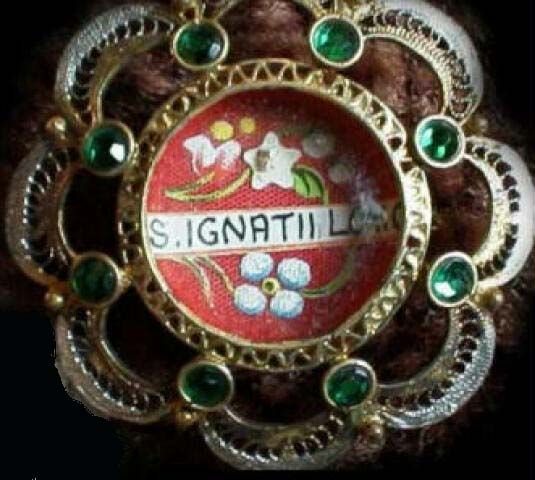
First class relics, actual fragments of a saint's body, are the most highly venerated relics in the Church, and a relic of St. Ignatius of Loyola, founder of the Jesuits, is a treasure in any collection.
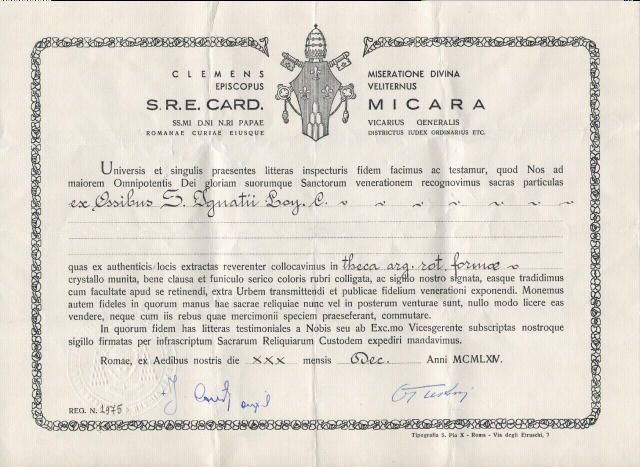
What sets this relic apart is that it has never been separated from its original authentic. Over the years, countless relics lost their documents, which were tucked away in some "safe" place and forgotten. This one still has the authentic issued in Rome in 1964 and signed by Cardinal Clemente Micara, who served under Popes Pius XII, John XXIII, and Paul VI, so its history can be traced directly back to the Vatican.
Its ornate filigree theca, with tiny flowers hand painted by religious sisters, is a devotional art form that has all but disappeared along with the religious vocations that produced it.
Photos
About this piece
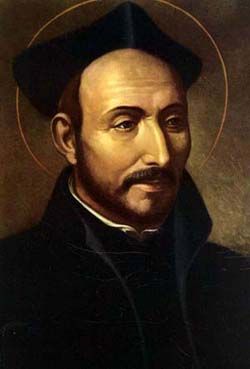
Saint Ignatius of Loyola was a Spanish Basque priest and theologian, who founded the religious order called the Society of Jesus and became its first Superior General.
This is a closeup view of the relic of St. Ignatius Loyola. The actual bone chip is on the star shaped design at the top. The silver filigree work, and the stones set this locket or "theca" apart from the more common, less ornate variety. But its most distinguishing feature is the hand painted artwork inside. Almost always done by dedicated, saintly nuns, it would be hard to imagine anything like it today; given the lack of religious vocations in the Church and the amount of time and labor involved.
The statue and reliquary
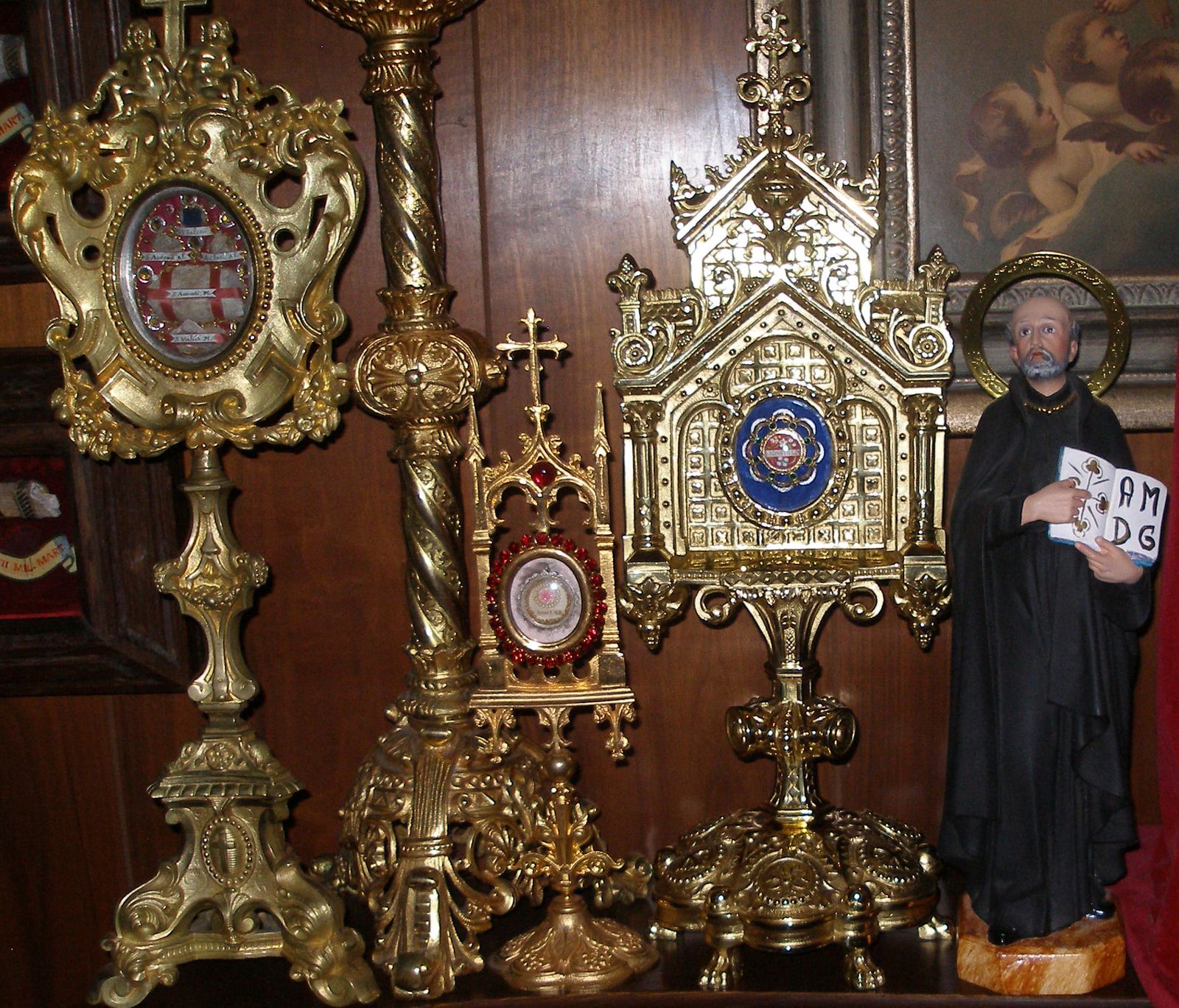
This statue is in typical Spanish style. It is hollow, formed out of a mixture of resin and sawdust, hand painted with glass eyes. The use of halos is most prevalent in Spanish statuary, even today.
The reliquary was made in France, circa 1880. Heavy cast bronze in typical French Gothic, exemplified by the footed base and fleur-de-lys cross. Standing 18" tall, it was originally part of an identical set of four, placed on the altar between the High Mass candlesticks.
The document of authentication
This is a closeup of the document, commonly referred to as an "authentic".
Given the abuses that occurred with relics during the Middle Ages, the Council of Trent decreed that all relics must be accompanied by such a document. While typically written in latin, it was not a requirement. It is not unusual to find them written in french, spanish, and in the case of some more recent american relics, english.
While the exact wording may vary slightly, the basic form is the same for all.
An English translation of the Latin for this particular authentic is provided below.
Clemens by the mercy of God Bishop of Velletri
His Reverend Eminence Cardinal Micara
Vicar General of the Roman Curia of our most Holy Lord the Pope,
and engaged as his Ordinary Judge etc.
We assure and bear witness to all those who will jointly and singly inspect the present document that, for the greater glory of Almighty God and the veneration of His Saints, we have acknowledged that these holy particles are from the Bones of St. Ignatius Loyola, which we have taken from their authentic place and reverently placed in a case in the shape of a silver circle, decorated with crystal, firmly closed and bound with a silk ribbon of a red colour, and signed with our seal, and that we have handed them over with permission to keep for oneself, to take outside the City, and to expose for the public veneration of the faithful. However we remind the faithful into whose hands these sacred relics have now come, or will come in future, that they may on no account sell them nor exchange them for articles which are intended to be traded.
As proof of this we have issued instructions that this testimonial document, signed below by Ourselves or by my most excellent Deputy, and confirmed by our seal, should be made ready by the below signed Guardian of Holy Relics.
Rome, from our House on the 30th day of the month of December in the year 1964.
[two signatures]
Registration No. 1975
See where this relic is displayed in Our Family Oratory.